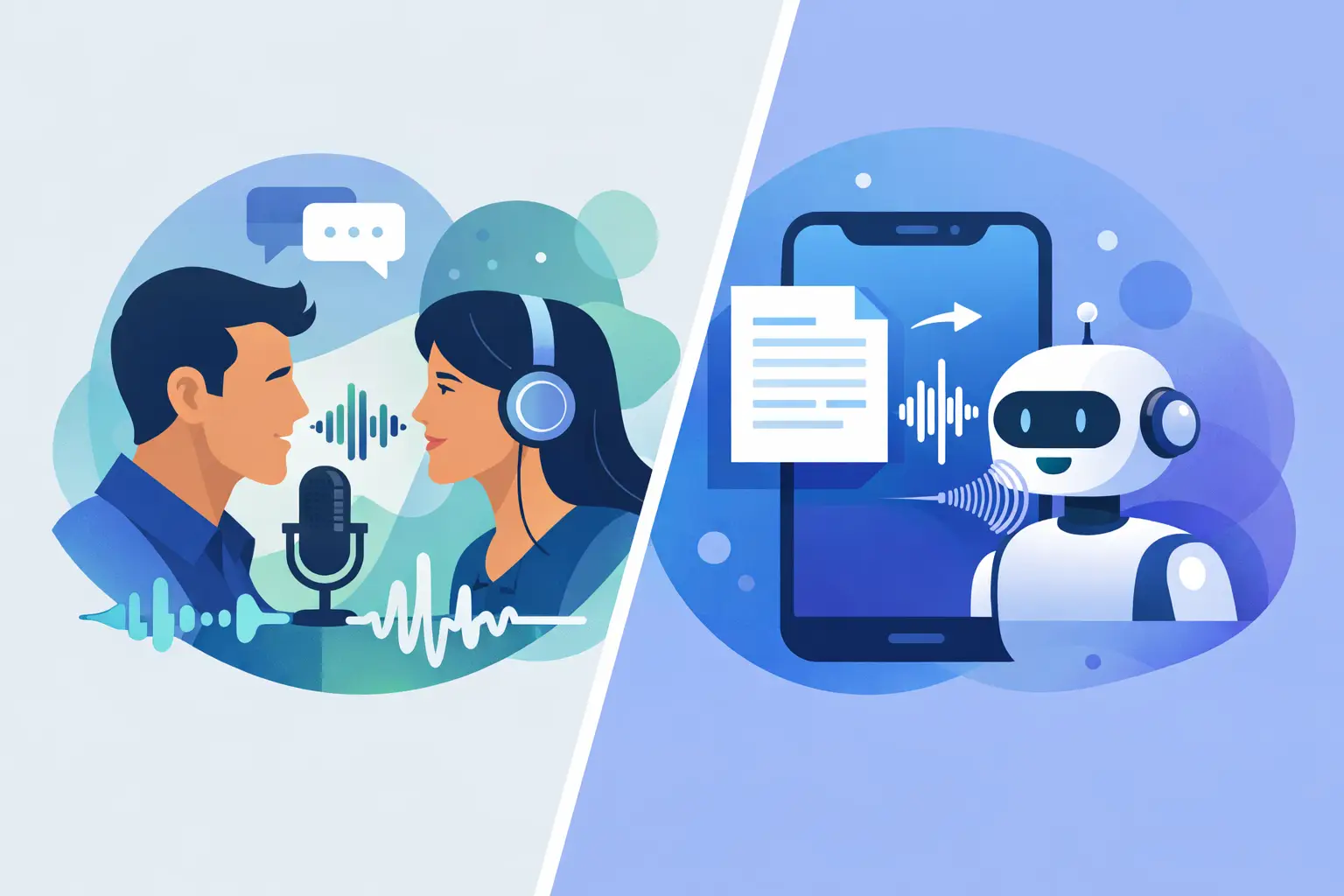
Speech to Speech vs Text to Speech
Speech to speech vs text to speech: learn the difference, where each fits, and why real-time voice AI changes customer calls.
On this page
- Speech to speech vs text to speech: the real difference
- Why text to speech still has a place
- Where speech to speech pulls ahead
- Speech to speech vs text to speech in customer operations
- The latency issue most buyers underestimate
- Cost, control, and implementation trade-offs
- When to choose each one
- What this means for AI voice buying decisions
A customer calls to reschedule an appointment, changes their mind halfway through the sentence, interrupts with a new date, and asks a follow-up before your system finishes speaking. That is where speech to speech vs text to speech stops being a technical comparison and becomes an operations decision. If your business handles live conversations, the difference affects speed, containment, customer satisfaction, and cost.
At a high level, text to speech converts written text into audio. It is the voice layer many teams already know from IVRs, reading assistants, and scripted voice bots. Speech to speech takes spoken input and produces spoken output directly in real time, without forcing every interaction through a rigid text-first pipeline. For businesses automating phone calls or voice support, that architectural difference matters more than it may seem.
Speech to speech vs text to speech: the real difference
Text to speech, or TTS, is a one-way output technology. A system generates text, and the TTS engine reads it aloud. On its own, it does not listen, interpret interruptions, or manage conversational timing. It is useful when the message is fixed, predictable, or mostly transactional.
Speech to speech is built for live interaction. The system hears the caller, interprets intent, and responds in audio with low enough latency to feel conversational. In modern AI voice systems, this often means processing audio directly and reacting fast enough to handle turn-taking, barge-in, hesitations, and changes in intent.
That difference shows up immediately in customer experience. TTS can sound polished, but it often feels sequential. The caller speaks, the system processes, then reads a response. Speech to speech is designed to feel more like an actual exchange, where the system can respond naturally and avoid the awkward stop-start rhythm that makes many voice bots feel robotic.
Why text to speech still has a place
Text to speech is not outdated. It is simply better suited to narrower jobs.
If your business needs to read order updates, payment reminders, account balances, or menu options, TTS can be efficient and cost-effective. It works well when the output is standardized, the interaction path is limited, and the customer does not expect much conversational flexibility.
TTS also gives teams control. Compliance-heavy scripts, multilingual announcements, and fixed responses are easier to govern when the wording is explicit. For some use cases, that predictability is a strength, not a limitation.
The trade-off is that TTS alone does not solve conversation. Once callers interrupt, ask layered questions, or speak in messy real-world language, the overall experience depends on everything around the TTS engine. If the orchestration is slow or brittle, a natural-sounding voice will not save it.
Where speech to speech pulls ahead
Speech to speech is built for businesses that need actual back-and-forth. That includes customer support, appointment scheduling, lead qualification, intake flows, and inbound service calls where customers rarely follow a script.
In these environments, latency is not a nice-to-have. It is the experience. If the system takes too long to react, callers talk over it, repeat themselves, or ask for a human before automation has a chance to help. If it cannot handle interruptions, it creates friction right when customers need speed.
Speech to speech reduces that friction because the interaction stays in audio from end to end. The system can detect pacing, respond faster, and keep the exchange moving. For operations teams, that translates into better containment rates, shorter handle times, and fewer abandoned calls.
This is why speech to speech is becoming the better fit for businesses replacing legacy IVRs or basic voice bots. It is not just about sounding better. It is about performing better under live conversational pressure.
Speech to speech vs text to speech in customer operations
For business leaders, the most useful way to compare speech to speech vs text to speech is by job type.
If the goal is broadcasting information, TTS is often enough. If the goal is resolving issues through conversation, speech to speech is usually the stronger option.
Take e-commerce support. A TTS-based flow can read shipping status well enough. But if a customer says, "Actually, I need to change the delivery address," then asks whether the package can be delayed and whether the payment method can be updated, the interaction quickly becomes multi-intent. That is where speech to speech starts to justify itself.
In healthcare scheduling, patients often pause, restart, ask about timing, or mention constraints that do not fit neatly into menu trees. In real estate, inbound leads ask open-ended questions and expect immediate, human-like pacing. In service businesses, callers want fast answers and smooth escalation when needed. These are all cases where speech to speech can outperform a text-driven voice experience because it is designed for fluidity rather than script playback.
The latency issue most buyers underestimate
Many teams evaluate voice AI based on voice quality alone. That is a mistake. A great voice with slow response time still feels broken.
The practical question is how long it takes the system to hear, reason, and reply. Every extra delay adds conversational drag. Callers notice dead air faster than most teams expect, especially on phone calls where there is no visual feedback.
This is one reason modern speech-to-speech systems are gaining traction. Lower latency creates a tighter conversational loop, which makes the interaction feel more natural and more competent. For businesses, that can mean higher automation success without sacrificing customer experience.
A fast system also handles interruptions better. Real callers do not wait politely for machines. They cut in, clarify, and change direction. If your voice automation cannot adapt in real time, customers end up fighting the interface instead of solving their problem.
Cost, control, and implementation trade-offs
Text to speech is often easier to deploy in simple flows. If your workflow is mostly scripted and your business just needs spoken output on top of existing logic, TTS can be the cheaper path in the short term.
Speech to speech can require a more capable stack, especially when you want real-time performance, integrations, call routing, CRM updates, calendar actions, and escalation to human agents. But the ROI picture changes when call volumes rise and conversations become less predictable.
A cheaper voice layer that fails on real interactions often creates hidden costs. More transfers. More repeat calls. More agent load. Lower customer satisfaction. By contrast, a stronger speech-to-speech system can reduce staffing pressure and improve availability because it handles more of the conversation successfully on the first attempt.
It also depends on how much control your team wants. Some companies want self-serve deployment and the ability to bring their own AI and telephony providers. Others need enterprise support, compliance guardrails, and SLA-backed implementation. The right choice is not just about the model. It is about how the voice stack fits your operating environment.
When to choose each one
Choose text to speech when your interaction is mostly one-way, your outputs are predefined, and the business case is straightforward. Status notifications, scripted reminders, and limited-response flows are good examples.
Choose speech to speech when your customers speak naturally, interrupt often, and expect the system to keep up. That includes inbound support, qualification calls, appointment booking, service triage, and any workflow where callers do not stay inside a narrow script.
For many companies, the answer is not purely one or the other. Some voice systems combine both approaches. They may use highly controlled TTS for regulated statements and a speech-to-speech layer for the actual conversation. That hybrid model can make sense when you need both flexibility and precision.
What this means for AI voice buying decisions
If you are evaluating vendors, do not stop at asking whether they support voice AI. Ask how they process audio, how they handle interruptions, what latency they deliver, and how easily they integrate with your current workflows.
A demo can hide a lot. Scripted success is easy. Real performance shows up when a caller rambles, changes intent, or asks something unexpected. The right platform should not just produce audio. It should help your business move faster, resolve more calls automatically, and preserve a smooth handoff when a human needs to step in.
That is where platforms built around real-time speech to speech, including solutions like Kalem, can create a meaningful operational edge. They are not simply adding a voice to automation. They are making automation behave more like a competent front-line agent.
The best choice comes down to the kind of conversations your business actually has. If your customers just need information read back to them, text to speech can do the job. If they need a fast, natural exchange that keeps up with how people really talk, speech to speech is the standard to measure against. When the phone is your front door, conversational speed is not a feature. It is the difference between a completed interaction and a lost one.