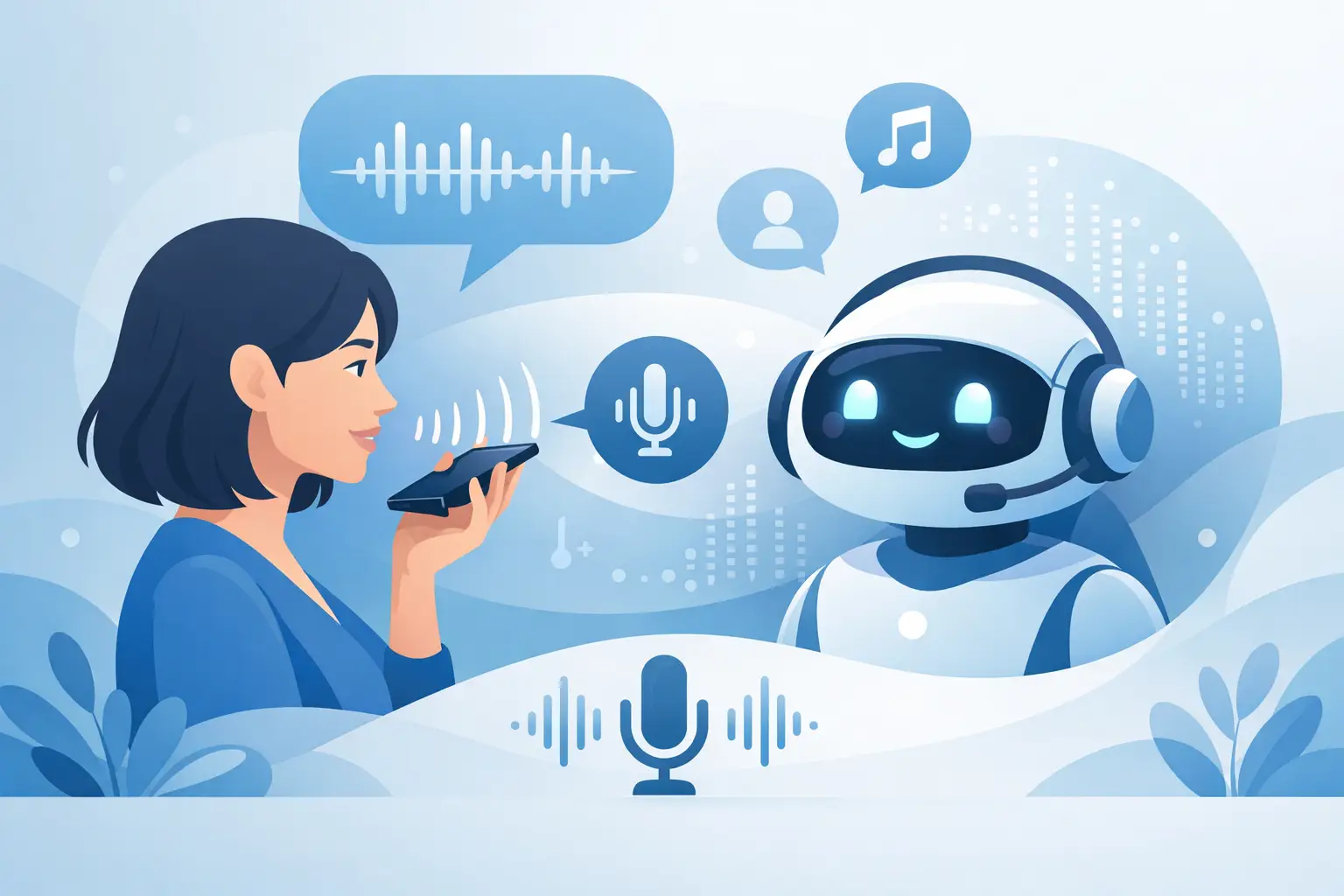
What Makes a Natural Sounding Voice Bot?
Learn what makes a natural sounding voice bot effective, from latency and turn-taking to voice quality, integrations, and business results.
On this page
- Why a natural sounding voice bot matters
- The core traits of a natural sounding voice bot
- Where most voice bots still fall short
- How to evaluate natural sounding voice bot performance
- Business use cases where natural voice delivers clear ROI
- What implementation should actually look like
- The future standard is not just automation
Most teams know the moment a phone automation project fails: the customer says hello, pauses for half a second too long, gets a stiff scripted response, and starts asking for a human. A natural sounding voice bot changes that dynamic. It responds fast, handles interruptions, keeps context, and sounds like it belongs in a real customer conversation instead of a legacy IVR maze.
That difference matters because voice is unforgiving. In chat, a slight delay feels acceptable. On a phone call, even a few hundred extra milliseconds can make the interaction feel awkward or fake. Buyers evaluating voice automation are not just choosing an AI feature. They are deciding whether customer support, scheduling, lead qualification, and order updates can be handled at scale without damaging trust.
Why a natural sounding voice bot matters
A voice bot is judged in seconds, not minutes. Customers rarely care how advanced the stack is if the first exchange feels robotic. They care whether the bot understands what they said, whether it responds without lag, and whether it can handle a normal conversation flow that includes interruptions, corrections, accents, and incomplete sentences.
For businesses, that translates directly into performance. A more natural interaction usually means higher containment, fewer abandoned calls, better lead capture, and less pressure on human teams. It also reduces a hidden operational cost: the cleanup work that agents do after a poor bot handoff. If the system loses context or forces callers through rigid prompts, agents inherit frustrated customers and longer handle times.
This is why realism is not a cosmetic feature. It is part of the business case. If the bot sounds human enough to keep the conversation moving, automation becomes useful in production, not just impressive in a demo.
The core traits of a natural sounding voice bot
The first requirement is low latency. Fast response time is what makes the interaction feel live. When a bot takes too long to speak, callers start talking over it, repeating themselves, or assuming the line is broken. The result is friction that compounds with every turn.
The second is interruption awareness. Real conversations are messy. People change their mind mid-sentence, ask two questions at once, and cut in when they already know where the answer is going. A natural system needs to detect that and adapt in real time instead of forcing the caller to wait for a canned audio block to finish.
Third is speech quality. A good synthetic voice does not need to imitate a specific person. It needs the right pacing, intonation, and clarity for the use case. A healthcare appointment reminder should sound calm and precise. A sales qualification flow can be more energetic. The best voice is not the most dramatic one. It is the one that matches the customer moment.
Then comes contextual memory. Natural conversation depends on continuity. If the caller says, "I need to reschedule my appointment from Thursday to Friday," the bot should not ask what appointment they mean on the next turn if that information is already available. Memory across a call is the baseline. In many workflows, memory across channels and past interactions becomes just as valuable.
Finally, the bot needs good judgment about when not to automate. Some requests should transfer immediately to a human. Billing disputes, sensitive medical issues, and high-value escalations often need a clean handoff with full context passed along. The fastest way to make a voice bot feel unnatural is to trap callers inside it.
Where most voice bots still fall short
A lot of systems sound decent in a polished demo and underperform in production. The usual problem is architecture. Older voice automation stacks often rely on separate speech recognition, language processing, and text-to-speech steps stitched together with too much delay between them. That gap creates the robotic rhythm customers notice instantly.
Another issue is over-scripting. Teams try to control every outcome with rigid decision trees, then wonder why the calls feel unnatural. Scripted logic still has a place, especially for compliance-heavy workflows, but it should support the conversation rather than dominate it. Customers do not speak in button-menu logic.
There is also a trade-off between openness and control. Some businesses want a simple self-serve setup they can launch quickly. Others need custom telephony, their own OpenAI credentials, CRM-specific logic, data residency requirements, or SLA-backed deployment. A voice bot that sounds natural but cannot fit the company’s infrastructure or compliance model will stall before rollout.
How to evaluate natural sounding voice bot performance
If you are assessing vendors or building internally, skip vanity claims and test the interaction under real call conditions. Ask how the system performs when the caller interrupts, speaks quickly, mumbles, changes topic, or asks a question the flow did not expect. A natural sounding voice bot should stay coherent without sounding defensive or confused.
Measure latency at the conversation level, not just component level. It is easy to claim fast transcription or fast generation in isolation. What matters is time to first meaningful response on a live call. If the exchange drags, the caller feels it immediately.
You should also test handoffs. Transfer quality is part of the voice experience. If the bot can recognize limits, summarize the issue, and route to the right human team, customer satisfaction stays intact even when the AI does not complete the task.
Integration depth matters too. Natural conversation alone does not solve the business problem. The bot needs to do something useful with the interaction, whether that is updating a CRM, checking an order status, booking a calendar slot, triggering a webhook, or qualifying a lead. Voice realism without workflow execution is just a better-sounding dead end.
Business use cases where natural voice delivers clear ROI
Customer support is the most obvious starting point because call volume is repetitive and often time-sensitive. Order tracking, account questions, return policies, and store hours do not need to consume human capacity if the voice experience is fast and accurate.
Appointment scheduling is another strong fit. When callers can book, confirm, cancel, or reschedule in a conversational way, missed calls drop and staff stop playing phone tag. In healthcare, home services, and real estate, that speed turns directly into better utilization.
For sales teams, inbound lead qualification is where natural voice can outperform static forms and voicemail funnels. A live, responsive call can capture intent, location, budget, urgency, and next-step preferences while routing qualified prospects to the right rep.
The economics are straightforward. Better availability increases answer rates. More contained interactions reduce staffing load. Faster response times improve conversion and customer satisfaction. But results depend on fit. High-emotion edge cases, complex disputes, and sensitive compliance scenarios still need careful workflow design with human escalation built in.
What implementation should actually look like
The strongest deployments start narrow. Pick one high-volume workflow with clear success metrics, such as after-hours support, appointment management, or order status. That gives the team a contained environment to measure containment, transfer rate, average call duration, and downstream resolution.
From there, expand based on actual call data. Refine prompts, tune escalation logic, and adjust the voice persona to match the brand and use case. This is where platform design matters. If deployment takes weeks of custom engineering, iteration slows down and momentum disappears. If the system can be configured quickly and connected to existing telephony, CRM, calendar, and workflow tools, time to value is dramatically shorter.
This is also why infrastructure flexibility matters for more advanced teams. Some organizations want full control over telephony and model credentials. Others want managed implementation with compliance support and white-glove rollout. Both approaches can work. The right choice depends on internal technical capacity, procurement requirements, and how much customization the workflow needs.
Platforms such as Kalem are built around that reality: fast deployment for teams that need results now, with the technical flexibility to support more complex voice operations as volume grows.
The future standard is not just automation
The market is moving past the question of whether AI can answer the phone. The real question is whether it can do it without creating a worse customer experience. A natural sounding voice bot is becoming the baseline for serious operators because anything less breaks trust too quickly.
The winners in this category will not be the teams with the flashiest demo voice. They will be the ones that combine low-latency conversation, interruption handling, useful integrations, and smart human handoff into a system that performs under real business pressure. That is what makes voice automation commercially viable.
If you are replacing hold queues, missed calls, or underperforming IVR flows, aim higher than simple automation. The bar is now conversation that feels fast, capable, and worth staying on the line for.