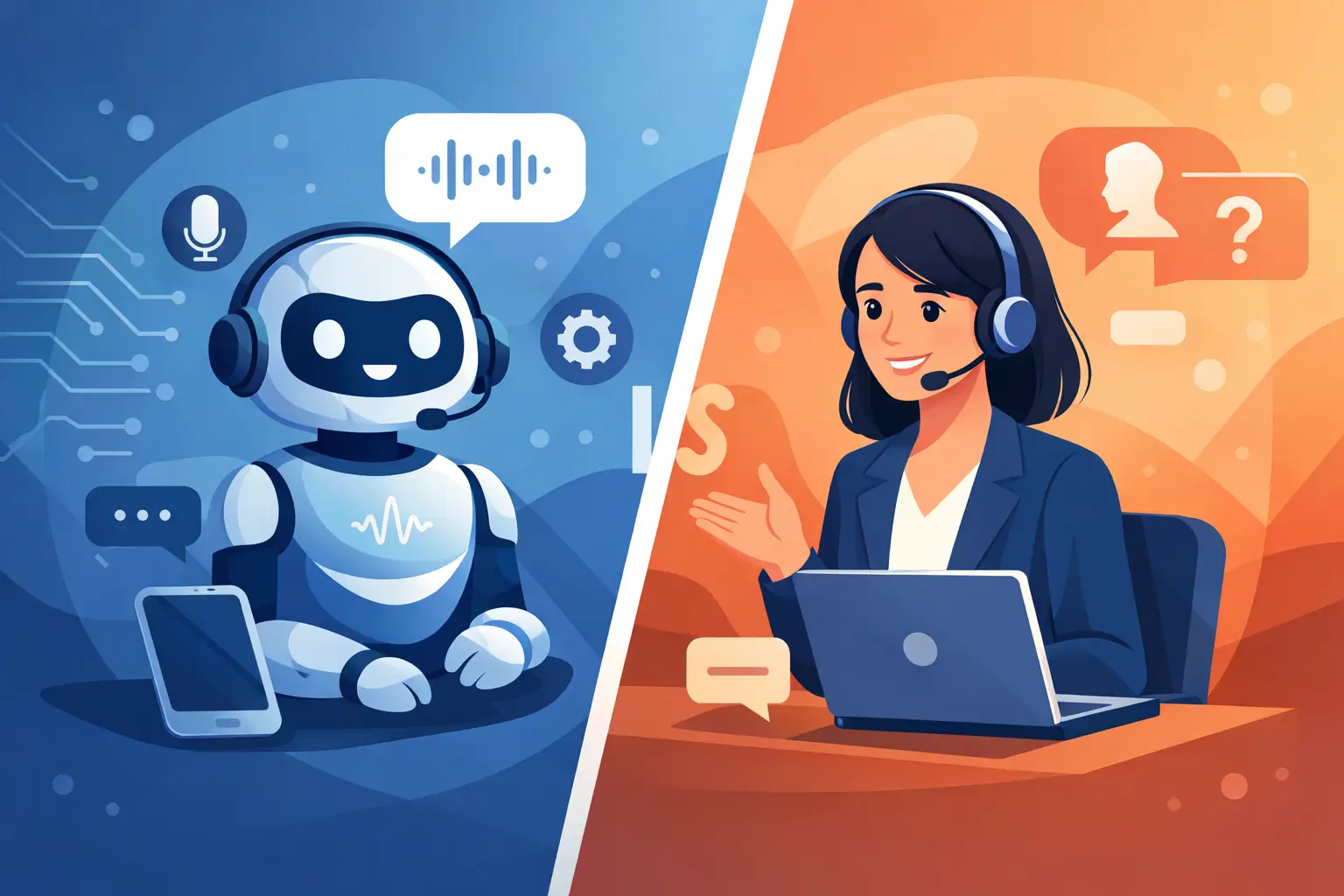
Voice Bot vs Live Agent: What Actually Wins?
Voice bot vs live agent isn't a simple choice. Compare cost, speed, CX, and scale to choose the right call handling model for your business.
On this page
If your team is still choosing between a voice bot vs live agent model as if only one can win, you're solving the wrong problem. The real question is which interactions need speed, consistency, and 24/7 availability - and which ones still need human judgment, empathy, or negotiation.
That distinction matters because inbound calls are expensive, uneven, and hard to scale with people alone. At the same time, bad automation can do real damage. A rigid phone bot that traps callers in scripted loops does not reduce support load. It creates repeat calls, escalations, and churn. So the decision is not automation or humans. It is where each performs best, and how fast you can move between them.
Voice bot vs live agent: the real comparison
On paper, live agents offer flexibility. They can read context, handle edge cases, calm down frustrated customers, and make judgment calls when policies do not fit the situation cleanly. For high-stakes conversations, that matters.
But live teams come with obvious constraints. Hiring is slow. Training takes time. Coverage gaps show up after hours, during spikes, and across languages or regions. Even top-performing teams vary from one call to the next. Quality assurance is expensive, and every additional call minute adds labor cost.
A modern voice bot solves a different set of problems. It can answer instantly, run 24/7, follow the same workflow every time, and manage high call volume without queue collapse. It does not get tired, it does not forget qualification steps, and it does not need seasonal staffing ramps. For recurring interactions like order tracking, appointment scheduling, lead qualification, FAQ handling, and status updates, that is a major operational advantage.
The catch is that not all voice bots are equal. Legacy IVR trees and slow, robotic bots trained buyers to expect poor phone automation. That assumption is outdated. A low-latency, interruption-aware voice agent that processes audio directly can handle natural turn-taking far better than older systems that force callers into unnatural pauses or keypad flows. When the conversation feels fluid, containment goes up and frustration drops.
Where live agents still outperform
There are still clear cases where a human should lead. Complex complaints, billing disputes with emotional tension, retention conversations, and nuanced B2B sales calls often benefit from a live agent. These interactions are less about retrieving information and more about balancing facts, tone, and commercial judgment.
Humans also outperform when the goal is relationship building rather than transaction completion. A strategic account conversation, a delicate healthcare escalation, or a real estate lead with unusual requirements may need someone who can improvise beyond system logic.
That said, "human-only" often becomes a default because teams have not mapped the call journey carefully. In many operations, agents spend large parts of the day repeating the same answers, collecting the same fields, verifying the same details, and routing the same requests. That work is necessary, but it is not where human talent creates the most value.
Where voice bots outperform at scale
A voice bot is strongest when the process is repetitive, time-sensitive, and easy to define. If the business already has a standard call script, decision tree, or routing policy, there is a good chance those interactions can be automated.
Customer support teams see this first with order tracking, appointment confirmations, policy questions, store hours, delivery updates, and account verification. Sales teams see it in inbound lead capture, qualification, callback scheduling, and follow-up. Operations teams see it in overflow handling when campaigns, promotions, or service outages spike call volume.
In these cases, the benefit is not just labor savings. It is response speed. A caller who gets an answer immediately is less likely to abandon, call back, or escalate unnecessarily. Fast response protects revenue, cuts queue pressure, and improves customer perception before a human ever gets involved.
This is why the strongest automation strategy is rarely about replacing every call. It is about removing delay and repetition from the front of the workflow. Companies that do this well can often reduce phone handling costs dramatically while giving live agents better conversations to work on.
Cost is not the only variable
Most buyers begin with cost, and fair enough. A live agent model is expensive because cost scales with headcount, occupancy, training, supervision, and attrition. If your inbound volume is growing, that curve gets painful quickly.
A voice bot changes the economics. Once deployed, it can absorb high volumes without hiring in the same way, and it can do it around the clock. That is where the headline savings come from.
But cost alone is a weak buying lens if the caller experience breaks. A cheaper call path that creates confusion, repeats, or drop-offs is not efficient. The better measure is cost per resolved interaction. If the bot handles the task correctly, captures clean data, and escalates only when needed, savings are real. If it fails containment and pushes work downstream, you are just moving the burden.
That is why speed, accuracy, transfer logic, and integration matter so much. A voice agent that can access CRM records, trigger workflows, update calendars, and pass context to a human agent performs very differently from a generic bot with no operational depth.
The best model is usually hybrid
For most businesses, voice bot vs live agent is not an either-or decision. It is a routing strategy.
The best model uses automation to handle the first layer of demand, then hands off to a human when the call needs discretion, empathy, or exception handling. That hybrid approach gives you the cost profile of automation without sacrificing the customer experience where people matter most.
A practical example makes this clear. Imagine an e-commerce support line. A voice agent can answer instantly, authenticate the caller, retrieve order status, explain delivery timing, and even start a return workflow. If the customer says the package was damaged and they are upset, the system transfers the call with the order context already attached. The live agent starts from the issue, not from zero.
That handoff is where many automation programs fail. If customers must repeat themselves after transfer, the value drops. Smart escalation should feel like continuity, not a reset.
This is also where platforms like Kalem stand apart from old-school phone bots. The value is not just answering calls with AI. It is handling speech naturally, responding with low latency, integrating into business systems, and transferring to humans with context intact.
How to decide what to automate first
Start with volume and predictability. Review the top call drivers in your operation and identify which ones follow a repeatable pattern. If a large share of calls involves status checks, booking, qualification, routing, or scripted support steps, those are your first candidates.
Next, look at business risk. Do not begin with the most sensitive workflow unless your escalation path is strong. It is smarter to automate clear, bounded interactions first, prove containment and customer acceptance, and then expand.
Then evaluate infrastructure readiness. The question is not whether you can launch AI in theory. It is whether your voice layer can connect to the systems that make the call useful. If your agent cannot read customer data, write outcomes, schedule appointments, or trigger follow-up actions, the experience will feel shallow.
Finally, define the transfer threshold early. Decide what the bot should resolve, what it should collect, and when it should hand off immediately. That line is not fixed forever, but it should be clear from day one.
What buyers should watch for
If you are comparing vendors, avoid getting distracted by demo theatrics. Focus on the operational details that determine real-world performance.
Latency matters because unnatural pauses kill trust. Interruption handling matters because real callers do not wait politely for a prompt to finish. Integration matters because disconnected conversations create manual cleanup. And human transfer matters because no bot should be the final destination for every call.
You should also test for consistency under pressure. Can the system handle accents, background noise, and multi-step workflows? Can it manage high call volume without breaking the experience? Can your team deploy and iterate quickly, or will every change require a service ticket and delay?
Those details separate a voice layer that reduces workload from one that just adds another system to manage.
The strongest operators are no longer asking whether humans or AI should own the phone channel. They are redesigning call flows so every interaction starts in the fastest, most cost-efficient place and moves to a person only when that adds real value. That is how you scale service without scaling friction.