Speech to Speech AI: How It Works and Why Latency Matters
Speech to speech AI removes the text bottleneck between caller and model, delivering sub-500ms responses that finally sound human on the phone.
On this page
- What speech to speech AI actually means
- Why speech to speech beats the traditional STT-LLM-TTS pipeline
- How latency changes the whole call experience
- The role of OpenAI's Realtime API
- Where speech to speech AI delivers the most value
- The trade-offs teams should still plan for
- How Kalem applies speech to speech AI in production
For years, voice automation lived inside the same architecture: convert audio to text, send the text to a language model, convert the response back to audio, and play it. The pipeline worked, but it always sounded like a pipeline. Callers waited two or three seconds between sentences. The bot missed interruptions. Tone was flat because the model never actually heard the audio.
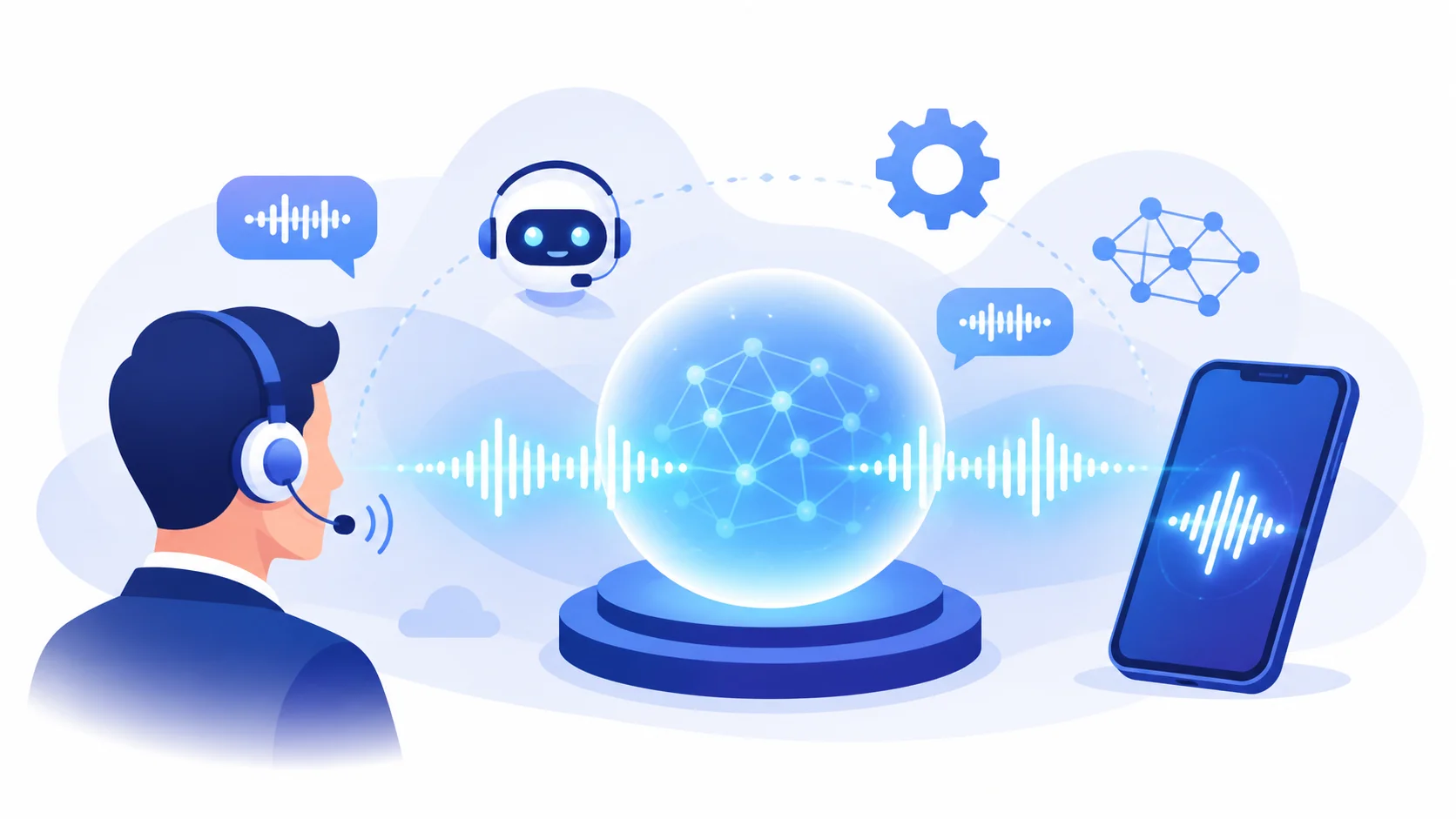
Speech to speech AI changes that. Instead of three separate systems passing data back and forth, a single model takes audio in and produces audio out. No text intermediary. No stitched timing. The conversation feels fast because the model is no longer translating the call twice.
That shift is why so many buyers are searching for speech to speech AI right now. They are not chasing a new feature. They are chasing the first version of voice AI that does not break the moment a real customer starts talking.
What speech to speech AI actually means
Speech to speech AI is a class of model that processes spoken audio natively and responds with spoken audio in the same forward pass. The model hears the words, the pauses, and the prosody. It generates output that carries timing and tone, not just sentences read aloud.
This is different from a chatbot bolted onto a TTS engine. Traditional voice bots work in three stages. First, a speech-to-text system turns audio into a transcript. Then a language model reads the transcript and writes a reply. Then a text-to-speech system reads that reply back to the caller. Each stage adds latency. Each stage drops information the next stage cannot recover.
A speech to speech model collapses those stages. The audio never leaves the model's domain. That single change is what unlocks natural turn-taking, interruption handling, and responses that arrive before the caller starts wondering whether the line dropped.
Why speech to speech beats the traditional STT-LLM-TTS pipeline
Latency is the obvious win, but it is not the only one. The pipeline approach loses signal at every handoff. Tone of voice, pace, hesitation, emphasis - none of that survives the conversion to plain text. The language model sees a flat string and replies with a flat string. The TTS engine then guesses how to read it.
Speech to speech models keep that signal intact. When a caller sounds frustrated, the model can respond more carefully. When a caller speaks quickly, the model can match the pace. When a caller interrupts, the model can stop talking and pivot. None of that is possible when audio has already been flattened into a transcript.
There is also a reliability dimension. Pipeline systems break in places that are hard to predict because three different services have to stay in sync. A speech-to-text error cascades into a wrong reply. A slow TTS render makes the whole call feel sluggish. Speech to speech reduces that surface area to a single model and a single audio stream, which is far easier to operate at scale.
How latency changes the whole call experience
Human conversation has a rhythm. The natural pause between speakers is about 200 to 400 milliseconds. Anything longer than 500ms starts to feel awkward. Past 800ms, callers assume something is wrong - they repeat themselves, talk over the system, or hang up.
Pipeline voice bots typically respond in 1.5 to 4 seconds. That is enough time for a caller to lose patience or shift topics. Speech to speech AI brings that down to roughly 300 to 500ms end to end, which is inside the natural turn-taking window.
The difference is not subtle. A 320ms response feels like a person who is paying attention. A 2,000ms response feels like a recording. Customers do not need to be told which one they are talking to. They can hear it. That is why latency is the single most important specification when evaluating any voice AI platform, and why speech to speech architecture has become the new baseline for production deployments.
The role of OpenAI's Realtime API
Most modern speech to speech voice agents are built on OpenAI's Realtime API and the gpt-realtime model family. The Realtime API exposes a streaming audio interface, function calling for tool use during a call, and native voice options that handle accent, pace, and tone through configuration rather than through a separate TTS layer.
What makes this practical for production is the combination of three things in one model: real-time speech understanding, reasoning, and speech generation. A platform integrating directly with the Realtime API can run the entire conversation through a single low-latency stream, then call out to backend systems for things like CRM lookups, appointment availability, or order status without breaking the flow of the call.
This is also why platform choice matters. Two products can both say they use OpenAI Realtime, but the way they bridge that API to real phone networks - SIP, PSTN, WebRTC - determines whether the latency savings actually reach the caller. Extra middleware layers can quietly add 200 to 500ms back to the round trip and erase the benefit.
Where speech to speech AI delivers the most value
The teams getting the most out of speech to speech AI are the ones with phone channels that are operationally heavy and emotionally sensitive. Healthcare clinics handling appointments and triage. Restaurants taking reservations and orders during peak hours. Home services dispatching jobs. Real estate teams qualifying leads. Logistics operators answering tracking calls. Any business where missing a call costs revenue and where sounding robotic costs trust.
For inbound support, speech to speech AI absorbs first-line volume - the repetitive questions about hours, status, and basic policy - and routes the harder calls to a human with full context. For outbound, it handles reminders, confirmations, and qualification at a pace that pipeline systems cannot sustain. In both cases, the value is not just automation. It is automation that does not damage the customer experience while it scales.
There is also a less visible win. Once a voice channel is reliable in real time, businesses start using it for things they used to push to email or web forms. After-hours bookings, payment follow-ups, post-service surveys, route updates. The phone becomes a working channel again, not a fallback.
The trade-offs teams should still plan for
Speech to speech AI is not a finished product. There are real edges to be aware of.
Voice quality is excellent in major languages but uneven across dialects. Code-switching mid-call - moving between English and Arabic, for example - is improving but not always graceful. Long calls with heavy context can drift if the platform does not handle session memory carefully. Some compliance scenarios require careful configuration, especially in healthcare and finance, where the data path needs to be tightly controlled.
There is also a cost dimension. Per-minute pricing on speech to speech models is higher than basic TTS. For most use cases that economics works out, because each automated minute replaces a more expensive human minute. But it does mean platforms with bring-your-own-credentials support are attractive at scale, since you can run on your own OpenAI account and your own SIP trunk rather than paying a markup on both.
The right way to handle these trade-offs is to evaluate them honestly during a pilot rather than discover them later. Test interruption handling. Test transfers. Test peak load. Test the languages your customers actually speak. The technology is strong, but the implementation around it is what determines whether it holds up in production.
How Kalem applies speech to speech AI in production
Kalem is built directly on speech to speech architecture rather than a STT-LLM-TTS pipeline. Calls are bridged from real phone networks into the OpenAI Realtime API through optimized WebRTC-to-SIP routing, with no unnecessary middleware between the caller and the model. End-to-end response time lands at around 320ms, which keeps conversations inside the natural turn-taking window.
The voices - Marin and Cedar - are fully configurable through system instructions, so accent, tone, pacing, and personality can be adjusted to match a brand without retraining. The same call session can detect interruptions, mirror the caller's language, and invoke backend tools mid-conversation through webhooks and APIs. That is what allows a single agent to answer a question, look up an order, transfer to a human with context, and log everything to a CRM, all inside one fluid call.
Kalem is also built around BYOC - bring your own OpenAI key and your own SIP trunk - which gives teams direct cost control, their own data processing relationship with the model provider, and no vendor lock-in on the telecom side. For agencies and operators who plan to scale beyond a pilot, that infrastructure flexibility is usually the difference between a clean rollout and a rebuild six months in.
Speech to speech AI is no longer the future of voice automation. It is the current baseline for any deployment that needs to feel human on the phone. The platforms that succeed from here will be the ones that pair the model with serious telephony, real integrations, and the operational discipline to run it at scale.